

Moving 20 legal entities to a new finance platform takes more than transferring transactions. Each entity brings its own data volumes, accounting periods, codes and reference structures, and every balance needs to reconcile before production release. These considerations guided property development and investment company Urban&Civic’s controlled migration, led by Eclipse, from Microsoft Dynamics NAV, commonly known as Navision, to Infor SunSystems Cloud.
 The Eclipse programme covered business unit setup and the configuration of relevant business processes to meet the client’s requirements. It also included transforming historical and current-period transactions, loading data in controlled stages and reconciling the results against the source system. At its core were 20 business units, 6 migration stages, 2 controlled environments: TEST and PROD - and one repeatable framework.
Why this migration needed more than a bulk transfer
Dynamics NAV and SunSystems Cloud organised financial information differently, so source data had to be mapped to the new accounting and analysis design. The migration also needed to accommodate revised datasets and newly identified mapping values without creating duplicates. Large volumes of historical transactions required staged processing, while each SunSystems Cloud balance had to reconcile with the corresponding Dynamics NAV trial balance. Environment configuration, access and Test-to-Prod (T2P) promotion also needed to remain controlled. The approach therefore combined progressive business unit setup with repeatable preparation and loading, reconciliation by account and period, and reviewed access permissions.
A six-stage approach to migration
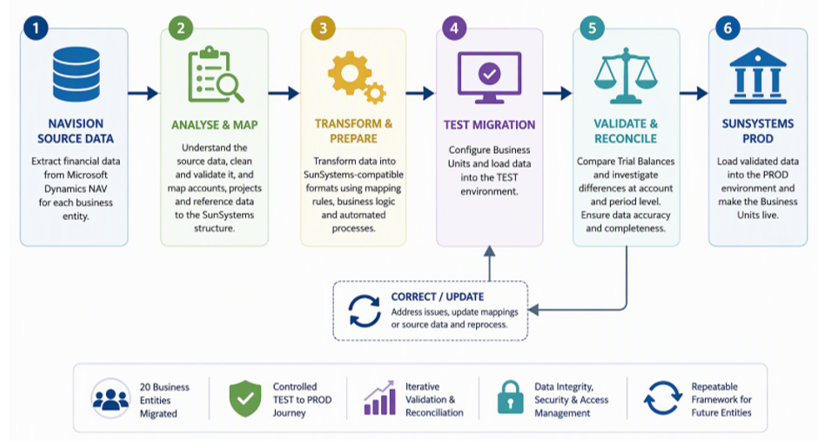
Rather than moving all data in a single bulk transfer, the 20 business units followed a repeatable cycle of preparation, testing and financial validation. Each entity progressed through six stages before release into production.
- Understand the source data
The first step was to review each entity’s ledger transactions, opening balances, accounts, journals and reference data. Assessing data quality, historical coverage and volume before processing established what needed to be migrated. - Map the SunSystems structures
Accounts, projects and other reference codes were mapped to the SunSystems accounting and analysis design. As additional source values emerged, the mappings were updated to reflect them. - Transform and prepare the data
SQL Server, T-SQL stored procedures and supporting scripts were used to cleanse and reshape the source data. This produced consistent files for controlled SunSystems uploads and made preparation activities repeatable. - Test each business unit
Each business unit was configured and loaded in TEST first. Results were reviewed, issues corrected and only the affected data rerun before the unit progressed to the next stage. - Validate and reconcile
SunSystems Cloud and Dynamics NAV trial balances were compared by account and period. Differences were investigated, data or mappings corrected, and the affected data reprocessed and validated again. - Promote to production
Only validated configurations and data moved to PROD. Data access groups and business unit permissions were reviewed as part of the controlled deployment.
These stages formed a controlled loop rather than a one-way process. Issues identified during reconciliation could be corrected, reprocessed in TEST and validated again without repeating the complete migration.
The controls behind the process
Financial reconciliation was built into every migration cycle. Data progressed only after differences had been investigated and the resulting balances validated. Period-by-period processing kept large historical transaction volumes manageable, while targeted delta files handled revised or additional data without duplicating the full load.
The outcome: one repeatable framework for 20 business units
The programme configured and progressively introduced 20 business units, processing historical and current-period ledger data through controlled stages. Mappings evolved as additional source codes and revised datasets emerged, and trial balances were validated against Dynamics NAV before production release.
Standardised transformation and migration preparation made the process repeatable. Combined with controlled TEST-to-PROD promotion and reviewed access permissions, this created a framework that can support subsequent entity migrations while maintaining financial accuracy, traceability and access control.
A controlled route to finance transformation
Urban&Civic’s move from Dynamics NAV to SunSystems Cloud shows why multi-entity finance data migration cannot be treated as a single bulk transfer. Structured mapping, repeatable transformation, business unit testing and reconciliation by account and period provided a controlled route into production, with validation built into the process, not left until the end.
Planning a finance data migration? Drawing on decades of experience in digital finance transformation, Eclipse uses a proven methodology to help organisations migrate their financial management to the cloud. For further information, please contact us on +44 (0)203 866 8800, send an email or: